Fire safety

Your safety is our priority. We carry out regular fire safety checks and risk assessments in all the homes we manage.
We are currently carrying out extra surveys and important fire safety improvements across all the homes we manage. We aim to carry out all these surveys and improvements with minimal disruption, but if you and your home are going to be affected, we'll be in touch directly to let you know in advance.
This page explains what to do in a fire, how to prevent fires, and how to check your smoke alarms.
- Fire Safety Management Policy
- Building Safety Policy
- Golden Thread Policy
- Mandatory Occurrence Reporting Policy
- Person-Centred Fire Risk Assessments (PCFRA) and Residential Personal Emergency Evacuation Plans (RPEEP) Policy
In a fire emergency, call Phone 999 immediately.
Fire safety in your property
Person Centred Fire Risk Assessments and Residential Personal Emergency Evacuation Plans
We can carry out Person Centred Fire Risk Assessments (PCFRA) and Residential Personal Emergency Evacuation Plans (RPEEP) if you think you need one. This could be because of a health condition, mobility issue, vulnerability, or any other concerns.
These assessments help us identify any specific needs you might have in the event of a fire or emergency. Once completed, we will put the appropriate measures and support in place. You can call or email your Housing Officer to request either of these assessments.
Know your building's evacuation plan
If you live in a flat or maisonette, your building has a fire evacuation plan. Check the fire action notice in your communal area. It tells you whether to evacuate immediately or stay in your flat.
There are two types of evacuation policy:
- Simultaneous evacuation - everyone leaves the building when the alarm sounds.
- Stay put - you stay in your flat unless the fire is in your flat or affects your safety.
Find out now which policy applies to your building. Check the fire action notice next time you're in the communal area.
If your building has a Simultaneous evacuation policy
In the event of a fire alarm everyone must leave the building immediately, regardless of where the fire is The fire alarm system has been designed to be heard throughout the building to ensure that every resident is alerted at the same time. Escape routes are kept clear and if you hear the alarm you should leave the building immediately.
- Get everyone out, close the door and walk calmly out of the building.
- Do not use the lift.
- Call 999 give your address, the number of your flat and the number of the floor the fire is on.
- It may be safer to stay in your flat or maisonette until the fire brigade arrives.
- Find a safe room, close the door and use soft materials to block any gaps to stop the smoke from entering.
- Call 999 and tell them where you are.
- Go to a window, shout "HELP, FIRE".
- Be ready to describe where you are and the quickest way to reach you.
- It is easy to get confused in smoke so count how many doors you need to go through to reach the stairs.
- Familiarise yourself with the information on the fire safety notices.
- Leave the building immediately using the nearest exit and stairwell.
- Call 999
- Await the fire services arrival, safely outside the building.
If your building has a 'Stay Put' evacuation policy
You may also hear this called a 'Stay Safe' policy. This means:
- If there is a fire in your flat - you should leave the flat and the building.
- If there is a fire somewhere else in the building - you can stay in your flat and do not have to evacuate.
- If you are in the room where the fire is, leave straight away, together with anyone else, then close the door.
- Do not stay behind to try to put the fire out.
- Tell everyone else in your home about the fire and get everybody to leave.
- Close all doors in your flat on the way, including the front door and leave the building.
- Do not use the lift.
- Call Phone 999 ive your address, the number of your flat and the number of the floor the fire is on.
- Wait for the fire service to arrive safely outside the building.
Your building is designed to contain fire and smoke in the area where the fire breaks out for a period of time.
- Please stay within your flat unless you feel that your safety or your safe escape route is threatened.
- You must leave immediately if the fire service tell you.
You should leave immediately via a stairwell if fire or smoke affects any part of your flat. If you have any doubts or concerns, leave the building.
Communal areas
If you live in a flat keep shared corridors, stairwells, and stairs clear of rubbish and personal items. These are fire exit routes and must be kept clear at all times.
Always keep fire doors closed to ensure everyone's safety.
- If a fire is discovered whilst you are in the communal areas, leave the building if it is safe to do so. In these circumstances, you would be expected to make your own way out of the building.
- Do not use the lifts if your building has on.
- Once safely outside the building, contact the Fire Service to report the fire. Read our Homes and Neighbourhoods Clear and Safe - Safety in Communal Areas Policy.
Smoke and heat alarms
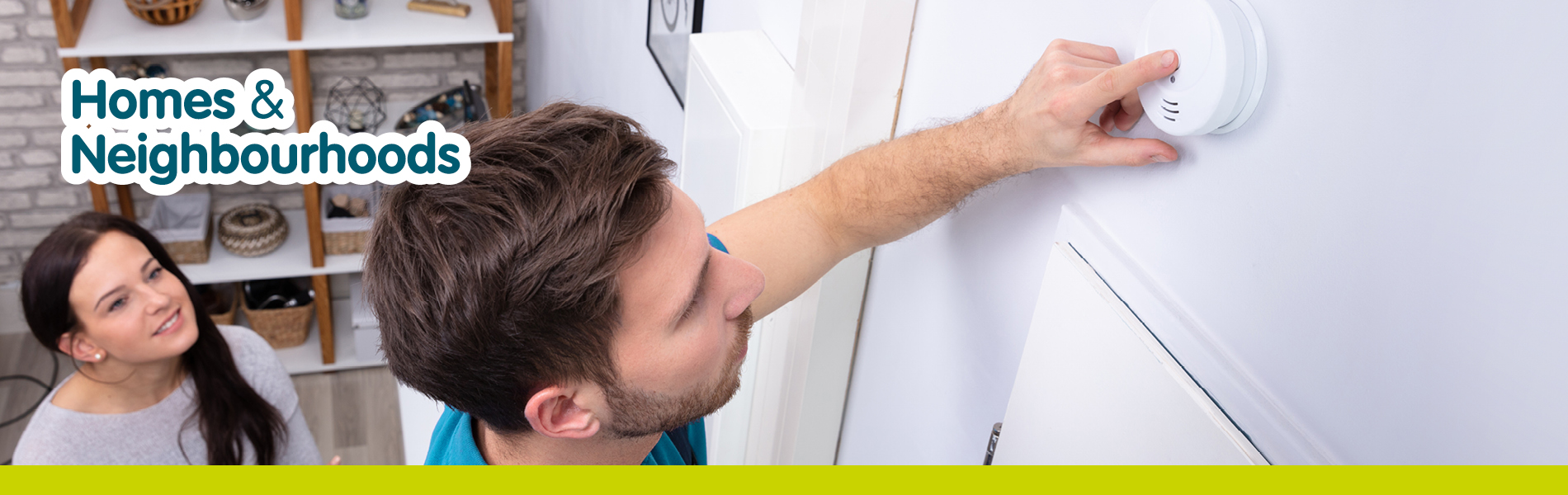
Test the alarms you have inside your home monthly by pressing the 'Test' button.
Always keep fire doors closed to ensure everyone's safety.
- If a fire is discovered whilst you are in the communal areas, leave the building if it is safe to do so. In these circumstances, you would be expected to make your own way out of the building.
- If your alarm begins to intermittently beep (indicating low battery), or if you have concerns about your alarms, please report a repair.
Balcony safety
We want your balcony to be a place to enjoy whilst considering your household and neighbours safety. When using your balcony, you must NOT:
- Light a fire on your balcony, including a disposal barbeque.
- Use a patio or outdoor heater.
- Discard cigarettes carelessly.
- Use fireworks.
- Store anything that could restrict your exit in the event of a fire.
- Hang clothing, rugs or mats over the railings.
- Screen your balcony with bamboo or straw type matting.
- Leave young children unsupervised.
If you have any questions about what can be kept on your balcony you can email us at HNfire@kirklees.gov.uk (check this email) or call our Building Safety Team on 01484 414886.
Items you CAN keep on your balcony:
- Pot plants in non-combustible pots up to 12 inches in diameter.
- Small window box.
- Low level clothes airers that are lower than the handrails.
- Folding or small table and chairs.
- Number of chairs must not be more than the number of residents for the premises.
Please don't keep any items close to the edge of your balcony, it could be dangerous if anything falls or is climbed on.
Items you CANNOT keep on your balcony:
- Anything flammable.
- Barbeques.
- Wooden or paper items, or products.
- Furniture, other than small table and chairs detailed above.
- Decorating materials.
- Bags of rubbish.
- Cooking oil, cooking equipment, or oil cans.
- Any electrical items, including fridge freezers or tumble dryers.
- Exercise equipment.
- Permanent structures such as a shed or cupboard.
- Patio heaters or gas cannisters.
- Bikes, prams or pushchairs.
Preventing common fires in your home
Cooking is the most common cause of house fires.
- Never leave pans unattended, especially with oil or fat.
- Keep flammable items like cloths and packaging away from naked flames and always keep the area around the hob/oven clear.
- Do not overload sockets or adapters; use only one plug per socket.
- Regularly inspect cables and plugs; discard and professionally replace any damaged ones.
- Unplug appliances at night or when not in use, except essentials like freezers.
- Use suitable ashtrays, fully extinguish cigarettes before disposing of them.
- Don't smoke in bed.
- Do not smoke in communal areas.
- Place candles on stable, non-flammable holders.
- Keep away from curtains and furniture.
- Don't leave candles unattended.
- Only switch on air fresheners for a maximum 4 hours at a time.
- Keep at least 1m clear space; never use them for drying clothes.
- Use correct chargers.
- Follow manufacturer guidelines.
- Don't charge them overnight, on soft furnishings or along escape route
- Create and practice a fire escape plan, from each room, and designate a safe meeting place.
- Keep escape routes and exits clear, and ensure keys are accessible. Spare keys are good to have in the bedroom.
- On an evening, close internal doors to slow any fire/smoke spread. Make sure cooker and heaters are off and unplugged (except essential appliances); extinguish cigarettes and candles; unplug unnecessary electronics.
- Teach children about fire risk, what the alarm sounds like, and emergency procedures.
- Installation of specialist alarms is available (e.g. vibrating pad for under pillow, visual aid by way of a light source). If you require any support Email Contact Fire Safety.
- Some tenants or household members may have a condition or circumstance that could make it harder to detect a fire, respond quickly, or safely evacuate their home in an emergency. Please let us know if this is the case for you.
- Where a potential risk is identified, we will offer to work with the tenant to carry out a Person-Centred Fire Risk Assessment (PCFRA), and to develop a Residential Personal Emergency Evacuation Plan (RPEEP) where needed.
- You can contact your local fire service to request a non-judgmental Safe and Well Visits - West Yorkshire Fire & Rescue Service they may be able to provide tailored advice and install free alarms.
- Test smoke/heat alarms monthly.
- Never leave cooking unattended and keep cooking area clear from clutter.
- Check cables and plugs regularly, don't overload sockets.
- Unplug appliances at night (non-essentials).
- Use candles and heaters safely and never leave them unattended.
- Fully put out cigarettes before you dispose of them.
- Plan, practise, and keep escape routes clear.
- Before bed: close doors, unplug appliances and check exits are clear.
- Make sure children, older people, and disabled people have suitable alarms and plans in case of a fire.
- Book a free Safe and Well Visits - West Yorkshire Fire & Rescue Service
What would you do if you need to escape from your home quickly in the night? Do you have a plan? Be prepared by making a plan of escape.
- Plan an escape route and make sure everyone in your home knows the route. The best route is usually the normal route in and out of your home.
- Think of a second route in case the first one should become blocked.
- Take a few minutes to practice your escape plan - it could save your life.
- Make sure exits are kept clear at all times.
- Keep door and window keys where everyone in your home can find them.
- Close internal doors at night, as these can help to stop a fire from spreading.
- Don't tackle fires yourself. Leave it to the Fire Service.
- Keep calm and act quickly. Get everyone out as soon as possible.
- Don't waste time investigating what's happened or rescuing valuables.
- If there is smoke, keep low where the air is clearer. Before you open a door, check if it's warm. If it is, don't open it - the fire is on the other side.
- Call Phone 999 and report the fire as soon as you are clear of the building.
- Do not return to your home until instructed by the Fire Service.
- If you can't get out, get everyone into one room, ideally with a window and a phone.
- Put bedding or similar around the bottom of the door to block out the smoke. Phone Phone 999for the Fire Service or, if there is no phone, open the window and call "HELP! FIRE!"
- If you're on the ground floor, you may be able to escape through a window.
- Use bedding or something similar to cushion your fall and lower yourself down carefully.
- If you can't open the window, break the glass in the bottom corner. Make jagged edges safe with towels or blankets.
Free home fire safety check
West Yorkshire Fire and Rescue Service offer free "Safe and Well" visits. They'll give you tailored advice and can install free smoke alarms.
Book a free Safe and Well visit: Safe and Well Visits - West Yorkshire Fire & Rescue Service
Contact us
- Email Contact Fire Safety if you have any concerns about fire safety in your home.
- Phone 01484 414886
For further fire safety advise please visit GOV UK: Make your home safe from fire