Cookies on Kirklees.gov.uk

We use cookies to ensure that we give you the best possible experience on our website. You can change your cookie settings at any time.

Please note our website will work without cookies, but you will lose some features and functionality if you choose to disable cookies.

For more information see our cookies policy.

I accept cookies I do not accept cookies

Strictly necessary cookies

These cookies are strictly necessary to enable you to move about the site or to provide certain features you have requested.

Advertising cookies

We do not use any behavioural or advertising cookies on the Kirklees Council website.

Skip to content
  • Kirklees Council
  • Services
  • My accounts
  • A to Z
  • Services
    • Adult social care and health
    • Bins and recycling
    • Births, deaths and marriages
    • Business and economy
    • Children and families
    • Communities and volunteering
    • Connecting Kirklees
    • Council and democracy
    • Council tax and benefits
    • Crime and safety
    • Digital inclusion and accessibility
    • Housing and homelessness
    • Jobs and training
    • Leisure and culture
    • Licensing
    • Partners and professionals
    • Planning and development
    • Schools, education and childcare
    • Emergency contacts
    • A to Z of services
    • Make a payment
    • Report it
    • Adult social care and health
    • Bins and recycling
    • Births, deaths and marriages
    • Business and economy
    • Children and families
    • Communities and volunteering
    • Council and democracy
    • Council tax and benefits
    • Crime and safety
    • Digital inclusion and accessibility
    • Housing and homelessness
    • Jobs and training
    • Leisure and culture
    • Licensing
    • Partners and professionals
    • Planning and development
    • Schools and education
    • Transport, roads and parking
    • Emergency contacts
Council and democracy
  • Policies and strategies
  • Inclusive communities framework menu
  • Home
  • Forewords
    • Vision and foreword
    • Partnership foreword
  • The framework
    • Creating the framework
    • What we're trying to achieve
    • Supporting a strategic approach
    • Place-based engagement
    • Pillars of inclusive working
    • Implementation
    • Measures and impact
  • About the toolkit
    • The toolkit
    • Underpinning knowledge
    • The five inclusive approaches
    • Approach one: Connecting
    • Approach two: Communicating
    • Approach three: Equalising
    • Approach four: Trusting
    • Approach five: Celebrating
  • Self-evaluation tool

The toolkit

Best practice for Kirklees Partners
  • Home
  • Council and democracy
  • Policies and strategies
  • Inclusive Communities Framework

The Kirklees way of doing things

The Inclusive Communities Framework (ICF) Toolkit provides opportunities for partners across Kirklees to systematically adopt the five inclusive approaches, which are; trusting, equalising, celebrating, communicating and connecting. These constitute the Kirklees way of doing things, that would demonstrate that agencies are putting the principles into action.

The toolkit will ensure that we all have the confidence, competence and ability to act and measure how we play our part in building inclusive communities. It is designed to provide a guide that can be used either by individual agencies or collaboratively with others.
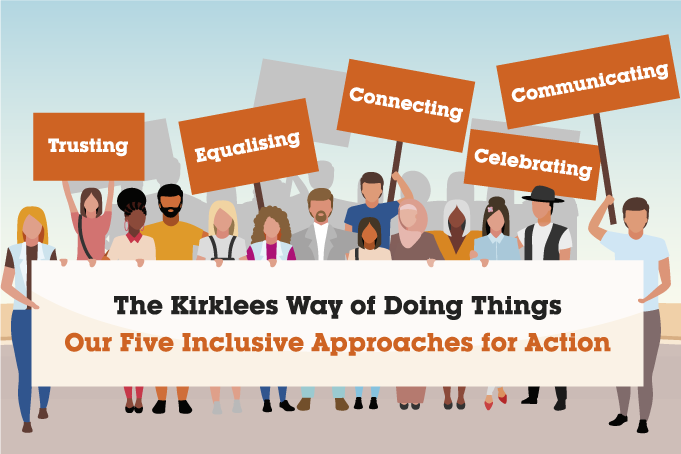
Graphic illustration of our five inclusive approaches for action: trusting, equalising, connecting, celebrating and communicating

What the toolkit includes

Underpinning knowledge

Key ideas and concepts that all partners should understand

The five inclusive approaches

Descriptions and evidence of good practice in Kirklees

Self-evaluation tool

How to evaluate our practice and demonstrate improvement actions

Who the toolkit is for

The toolkit is for use by leaders, managers, and teams, who want to understand more about the Kirklees way of doing things and how their organisation can play their part in contributing to inclusive communities. It can also be used as a tool to check in with your partners and communities, about how well you are doing in adopting these approaches in the work you are doing together.

The toolkit offers examples that are diverse, to reflect the breadth of roles and responsibilities that partners have across Kirklees. These can be adapted to ensure they are relevant and proportionate to your roles and responsibilities. You will find reference to examples of inclusive practice throughout the framework, supporting you to connect to others and work collaboratively on implementing the framework, sharing experiences and ideas across our partnership.

Was this information useful?

We'd like your feedback to improve the Kirklees Council website and the information we provide.

Kirklees Council

  • Contact us
  • Emergency contacts
  • Complaints

Standards

  • Website standards and guidance
  • Accessibility statement
  • Privacy Policy
  • Cookies Policy
  • How we use your data
  • Disclaimer and copyright

Digital Kirklees

  • My Kirklees Account
Digital Kirklees logo

Social

  • Facebook
  • Instagram
  • TikTok
  • Nextdoor
  • LinkedIn
  • Get email alerts
© Kirklees Council

Security warning

It looks like you're using an old, insecure browser that we no longer support.

In order to continue using secure areas of this website to do things like paying your council tax bill and searching for jobs you'll need to do one of the following:

  • upgrade to a newer, more secure web browser, or
  • change the security settings in your current web browser.
×