Place-based engagement
Working with people in local placesHow the Inclusive Communities Framework was developed
Through our place-based working programme, we are changing our relationship with local people, so that we can enable more people to shape their communities as citizens and not just deliver services to customers.
When we talk about having a 'place-based' approach, we mean working with and alongside our citizens and partners, where they are. It's about recognising and celebrating our unique local places and communities, their strengths and aspirations. Above all, it's about putting our relationships first and growing trust. We don't always have to be the people doing things or deciding things, our role is also about enabling others to act.
Place-based working involves meeting people and communities where they are, usually this means working together where people live. It's not only about where we live in Kirklees, it's about where we are in our lives and who we connect with. We all want to live in places where everyone can trust each other and working together builds trust.
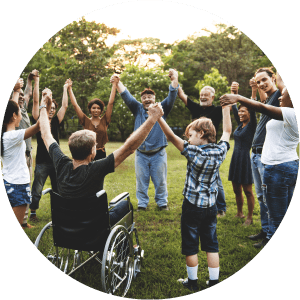
Local people told our democracy commission that they want to be part of 'ongoing conversations', not 'stop-start consultations'. In response, we developed a new Citizen Engagement Framework, which includes using the Place standard tool to have conversations about any place, it could be your street, neighbourhood or town. The conversations are often hosted by local groups or councillors, and they can happen in any setting, which is enabling more people to be included in conversations about where they live. The results give us some clear messages about belonging and influence.
All the activities and results are available online at: How good is our place?
Why we're creating the framework now
What we have been told and what we have experienced, working alongside communities during the pandemic, underpins the Inclusive Communities Framework (ICF). It forms the basis for our work to build relationships and approaches with all our communities and services. We need to ensure our ongoing conversations with communities are co-ordinated, shared, inclusive and results are heard, and actions agreed as a result. Equipping staff to have the skills and confidence to work alongside communities and feel empowered to do so, is key in this journey.
There has been no better time than now, to build on the momentum of the community response to the pandemic within Kirklees. However, inclusion does not just happen, it is an active process. It will take planning, thought and intention to create the conditions in Kirklees for inclusive communities.
Partners and services each have their own unique identity and ways of doing things; it is important for this diversity to be retained across the district, it reflects our communities and we have learnt that one size does not fit all. Many of us working with communities, particularly grassroots organisations and community anchors, already do this well and have been kind in sharing approaches and good practice, as part of the development of this framework.
We hope that colleagues, community groups and statutory services, will refer to the ICF at the early planning stages of any new work with communities and apply it to existing work. The ICF will help us to think and reflect on the work we are doing and seek inspiration and ideas. The toolkit will enable us to sense check our approach and build in evaluation of our work, to measure what we have done and help inform improvements next time around.
The Communities Partnership Board
The Communities Partnership Board will oversee and monitor the impact of the Inclusive Communities Framework. Individual organisations and services will, through evaluating work undertaken with communities, determine personalised framework implementation and action plans to improve or enhance practice. The ICF can be scaled up or down and can be applied in a way that is proportionate to the task. System leadership will be key to the framework's success in enabling a positive and consistent approach to our work with communities.
The Communities Partnership Board is chaired by an elected member of the council. It is a partnership of organisations including the police, health, probation, the Voluntary and Community Sector, elected members, the fire service and many other organisations.
Further information about the Communities Partnership Board: Safer Kirklees.
