Implementation
Action and supportAction one: Implementation plan

This process will provide the key monitoring and review function for the Inclusive Communities Framework (ICF). The scores from self-evaluations, along with the support and action plans, will be reviewed at both an organisational and a partnership wide level on an annual basis, as part of a continuous cycle of improvement.
The action and support plans will provide the main monitoring function of how well the ICF is being implemented across Kirklees, providing tangible ways of making recommendations across partners and other partnership boards
How the process works
Step 1: Partners develop their own organisational implementation plan which includes raising awareness of the ICF, what is required to implement it and how it will be measured and reporting requirements.
Step 2: Partners complete the ICF self-evaluation tool and develop an organisational support and action plan.
Step 3: Annual submission of an organisational support and action plan to inform a high-level, Kirklees-wide implementation plan, led by the Communities Partnership Board.
Step 4: An annual report on progress and a set of summary recommendations is provided to the Communities Partnership Board.
Step 5: A high-level progress update is provided to the Partnership Executive.
Using the toolkit documents, a set of implementation support workshops will be commissioned by the Communities Partnership Board. This will enable the ICF to be a dynamic framework and support ongoing learning and continuous improvement by:
- Routinely self-evaluating our work and relationships to communities.
- Connecting others to good practice.
- Delivering workshops on common themes identified by partners.
ICF workshops, for the first year of delivery, will focus on the foundational approaches to support organisations building their own understanding of these.
Action two: The self-evaluation tool
The self-evaluation tool will help us understand the impact the ICF is having on Kirklees communities, by considering each approach and reflecting on how well we are incorporating them into our work. It is not a precise impact measurement tool, but it does give us an indicator of how well we are doing, as well as both an organisational and partnership view of the actions we need to take to do even better.
By completing a self-evaluation of our work, we highlight what we have achieved, how well we have implemented the inclusive approaches, what we may do differently next time and what support we need for that. We are asking that each organisation commits to carrying out the self-evaluation on an annual basis. Organisations could choose to use the tool more often or for individual activities and programmes of work. Read more about the self-evaluation tool and full guidance on how to use it.
Action three: The role of leaders in implementing the ICF
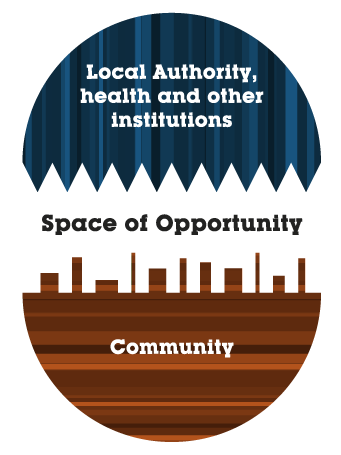
Strong leadership is needed to support our organisations and the staff in them, to make inclusive communities everybody's business. When we think of systems of leadership, institutions generally operate within a vertical leadership model, hierarchical, whereas, communities generally have a more organic, horizontal leadership model. These differing models of leadership can create tension with each other.
What the organisations can do as supporters and enablers, is explore the 'space of opportunity' where both organisations and communities can come together, to discover what is possible
Developing inclusive communities fits in to this space of opportunity and offers an approach to reduce the potential for tensions and increase the opportunity for collaboration and inclusive solutions being developed. Participatory community building guidebook 2020 is a guidebook to support successful community building.
Working in this space of opportunity is the key leadership objective and we need leaders at every level to demonstrate accountability, responsibility, be understanding and collaborative in order successfully implement the ICF.
Committed to having a visible commitment to inclusion, hold themselves and others accountable for how they contribute to inclusive communities. Provide high challenge and high support to the work delivered by their organisation and others in communities and building positive relationships. Strategic leaders will champion the ICF at every level, from implementation to championing the communities they work alongside.
Take responsibility for ensuring the system and processes are in place so that the ICF can be implemented fully. There is an expectation that partnership boards will regularly hold their partners to account and review how their collective work at the board is contributing to inclusive communities.
Leaders need to be curious about intelligence and insight, listening to communities as an essential part of their organisations data and intelligence.
Prioritise strong partnerships, use their own spheres of influence to drive and embed the ICF. Align resources, contributing to help create the conditions for inclusive communities.
Communities Partnership Board - leaders of change
The Kirklees Communities Partnership Board is elected member led and works alongside the Kirklees Health and Wellbeing Board and the Children's and Adults Safeguarding Boards and has a significant role in implementing and monitoring the impact of the Inclusive Communities Framework (ICF) across the district.
The board and its partners are key to articulating and achieving the vision of the Inclusive Communities Framework, by using the language of inclusivity and role modelling the guiding principles and approaches within their respective organisations and services. They will take individual and collective responsibility for championing the approaches required to achieve the system change priorities needed to create the conditions for inclusive communities.
As well as driving behavioural change, the board will monitor the impact of the ICF, by evaluating their own work and having oversight of the work of others. They will provide high challenge and high support to organisations working alongside our communities across Kirklees and hold each other to account, building positive and authentic relationships. The Board will hold the high-level implementation plan, with partners developing their own plans.
System leadership - shared responsibility
Whilst none of us are formally 'in-charge', adopting the guiding principles, approaches and toolkit of the Inclusive Communities Framework, enables all of us to be part of a wave of system leadership which inspires others to work in this way.
Working in this way will help to build competence, skills and knowledge across the system, strengthening local connections and trust within communities, giving us all the opportunity to contribute to developing and implementing inclusive communities and a shared vision of 'place'.