Introduction
Our focus
In Kirklees, we know that the environment matters. Without a thriving, healthy environment all the other plans we have for a better future cannot succeed. The environment underpins everything.
It is our home. It gives us the air we breathe, places to relax, resources for our businesses and jobs. It's where nature can thrive.
We want to make sure the environment is a priority. That's why we have made this a top tier strategy alongside the Kirklees health and wellbeing strategy, inclusive communities framework and the inclusive economy strategy.
Our top tier strategies are interconnected and cover all areas of sustainable development; environmental, economic, and social. Together, they are helping us to deliver a sustainable Kirklees.
We know the environment is not something any one organisation can address alone. That's why this strategy has been co-designed, bringing together council officers, key partners and people who live, work and study in Kirklees.
As a result, this strategy encompasses the environmental work delivered by Kirklees Council and partners and captures new, ambitious ideas for the future. Ideas that will take our action to a new level. We will deliver the strategy in the same way we have produced it - together. Like all of our top tier strategies, this is a partnership.
Our ambition
The ambition of our strategy is encompassed within a vision and four themes which contain 12 headline targets and 31 objectives all underpinned by our three always-on priorities.
Our four themes
Our strategy is structured by the following four core themes:


Always on priorities
Each of the four themes is underpinned by our always-on priorities. These are the three principles by which we have developed and will deliver the strategy:

Sustainable economic development (SED):
How the Kirklees environment strategy only supports progressive, sustainable opportunities for prosperity and wealth creation across the borough, and actively seeks to counter short term economic growth plans that work against our nature and climate targets.
Resilient futures (RF):
How the Kirklees environment strategy delivers greater ecological, social, and economic resilience for the future, including strong action on climate change adaptation, particularly to protect the most vulnerable people. This theme also ensures that our people are resilient and ready for the future, not least through learning new, transferable green skills.
Environment for all (E4A):
How the Kirklees environment strategy can support fairness, greater inclusion, diversity, and accessibility, particularly for people from ethnic minority backgrounds and those with disabilities. These groups have routinely been given less support on environmental issues and are also proven to be most at risk when it comes to environmental pressures.
Our 12 headline targets
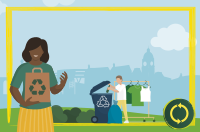
'Avoidable waste' refers to the things that we throw away that could have been prevented or avoided in the first place. It's the things we discard that still have value or could have been used more efficiently. Examples such as the food we throw away because it's gone bad before we could use or sell it, or designing out avoidable waste in our manufacturing and industrial processes - making them more efficient and less resource intensive.
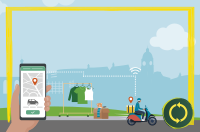
The 'sharing economy' is about sharing resources like cars, bikes, skills and equipment. It's focused on making more efficient use of these resources, whilst saving money and reducing waste. Examples include passing un-wanted clothing on to other rather than throwing it away, using tool libraries to borrow a drill rather than buy a new one, the use of car clubs, or community spaces that have multiple uses. For instance, village halls used for exercise classes and makers markets.
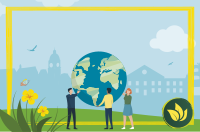
Nature recovery is the journey our district undertakes to enhance the health of our landscapes, wildlife and habitats by restoring them naturally. These areas have suffered damage or harm from things like pollution, deforestation and climate change. Activities include protecting wildlife and planting forests. Nature recovery is important because it helps protect the environment and keep ecosystems working properly, ensuring that we have clean air, water and places to enjoy nature.
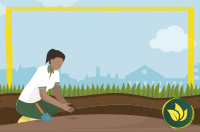
Peatland is one of Kirklees most precious natural habitats and is located in areas such as Marsden Moor and Holme Moss. Unfortunately, a lot of our peatland has been damaged or deteriorated over time due to human activity or changes to our weather and climate. Restoration is about returning the peatland back to its original state or condition, so the services it provides our communities can be enhanced, such as helping protect us from flooding, improving local water quality, storing carbon and supporting local biodiversity.

Tree canopy cover looks at the amount of ground area in the district covered by branches, leaves and stems from trees as viewed from above. This target is designed to ultimately increase the amount of trees within Kirklees. Tree canopy cover is important as it provides shade and helps regulate local temperatures in hot weather, especially in our towns and villages, it provides homes for birds and other animals whilst also helping to clean the air we breathe and absorb carbon dioxide.
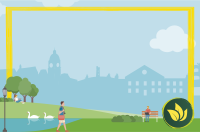
'Access to green and blue space' simply means having easy ways for everyone in Kirklees to get to natural areas like parks, forest, gardens and bodies of water like lakes, rivers and reservoirs. When we talk about access, we're talking about making sure everyone has the opportunity to enjoy and spend time in these natural areas due to their benefits for our physical and mental health and wellbeing.
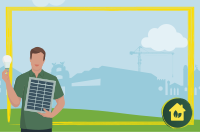
Buildings are where we live, work, socialise and relax. This target is about improving the quality of those buildings to ultimately reduce how much energy they take and money they cost to run. EPC stands for energy performance certificate. These are the nationally recognised way by which we grade the energy efficiency of our homes - they show how much energy the building uses and gives it a rating from A to G, A being the best, G being the worst.
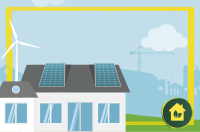
This target focuses on how we can reduce the greenhouse gas emissions we produce when generating heat and electricity, that we use. When we talk about 'net zero' we're aiming to produce as much clean, renewable energy (like solar or wind power) as we consume. We can do this by using energy more efficiently, investing in renewable sources and finding ways to offset any remaining emissions. We ultimately want to find a balance where the energy we use doesn't harm the planet and we're not using more energy than we sustainably produce.
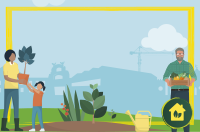
Sustainable neighbourhoods is all about making our neighbourhoods healthier, happier, safer and more sustainable for everyone who lives there, now and in the future. The focus is on making it easier to walk or cycle around, improving public transport connections and creating places where people can gather and connect with each other. It's about making sure that the way we live, work and play in our neighbourhoods helps everyone who lives there to have a good quality of life, whilst not impacting our natural environment.
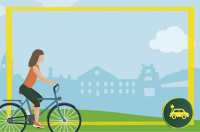
Sustainable journeys are about finding ways to travel that are good for the planet and our health without compromising on cost of convenience. This involves making choices that reduce our impact on the planet, whilst still getting were we need to go. Examples might be to choose electric cars over diesel and petrol if you can afford to, choosing to cycle, walk or wheel for shorter journeys if you're able, or using public transport like trains and buses where feasible.
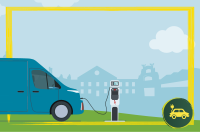
Applicable to businesses and organisations with a vehicle fleet, this target is about having a fleet of vehicles which don't produce carbon emissions when they are being used. This can be achieved by replacing diesel and petrol cars with electric or other alternative fuels that don't produce harmful emissions. This will help improve the air quality of the areas where these fleets operate, whilst reducing the carbon footprint of the organisation or business.
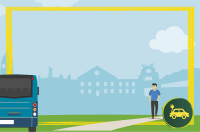
This target is about having easy ways to access public transport connection points like bus stops or train stations. We want to make it more convenient for residents to use public transport to get around. A 'safe pedestrian route' is a path or a way for people to walk or wheel to and from these connection points - making it easier and safe for them to do so.