Policy framework
Policy framework
The inclusive economy strategy has been developed during a period of change in the national policy landscape, with a new government adopting a renewed focus on economic growth with the publication of a series of strategic documents including the UK's Modern Industrial Strategy, the 10-Year infrastructure strategy and the Get Britain Working White Paper.
This section of the inclusive economy strategy presents an overview of the national, regional and local policy frameworks and the related policy drivers that will impact on the delivery of the strategy.
The government published The UK's Modern Industrial Strategy in June 2025. The strategy outlines the government's plans to deliver its priority mission "to deliver strong, secure, and sustainable economic growth to boost living standards for working people in every part of the UK".
The Industrial Strategy describes a new world era that is "more volatile, with new threats to our security and living standards" but also "a world of enormous and exciting possibility". It argues that we "need a new relationship between business and government, where government provides the strategic certainty that allows businesses to create wealth". The strategy seeks to create "ease, speed, and long-term stability for business" by "supporting the UK's city regions and clusters supporting our frontier industries and creating an enduring partnership with business".
While inventors, entrepreneurs and tech adopters being able to attract private investment is at the heart of the strategy, there is a clear strategic and coordinating role for the government who recognise the need to prioritise the interventions and investments that will deliver the largest growth benefit.
The Industrial Strategy focuses on creating "an independent, high-skilled, dynamic, and economically prosperous country, where opportunity, skills, and wealth are abound and are spread fairly; where jobs are high-quality, accessible, and secure; and where every person and every business have the chance to succeed". It also establishes net zero as a consistent priority, creating good clean jobs" while "boosting green manufacturing, services, innovation, exports, and the circular economy".
The Industrial Strategy identifies eight growth-driving sectors, as well as enabling foundational industries, supported by Sector Plans. These are:
- Advanced manufacturing.
- Creative industries.
- Life sciences.
- Clean energy.
- Defence.
- Digital and technologies.
- Professional and business services.
- Financial services.
There is a strong correlation between the government's priority sectors and those that are high performing or display future growth potential in Kirklees. The Industrial Strategy creates important opportunities to see the national policy and regulatory framework better support local business growth and investment, and the inclusive economy strategy complements this at the local level.
The Industrial Strategy green paper highlights the significant disparities in regional economic growth rates that have resulted in what is estimated to be a £47bn productivity gap for the eight largest cities outside London.
In this context Mayoral Combined Authorities have been invited to develop Local Growth Plans that will set out how they can unlock regional growth potential. In West Yorkshire, developing a Local Growth Plan (LGP) was also an earlier mayoral manifesto commitment.
The LGP aims to tackle the barriers to growth - investment, skills and connectivity - that are holding back growth in West Yorkshire. It sets out five high level priorities:
- Unlocking growth in priority sectors - creating an important interface with the sector-focused Industrial Strategy and the LGP identifies digital and tech, financial and professional services; health and life sciences, advanced manufacturing and engineering -including textiles, chemicals, food and drink, green economy, modern methods of construction and space - and the creative industries as key regional opportunities to drive growth.
- Enabling all businesses to succeed which details how public/private sector support for businesses will be developed; support for alternative business models and promoting good business practices including the Fair Work Charter.
- A region of learning and creativity - this sets out how West Yorkshire's education and training system will be enhanced, including new technical pathways; improving the transition between different stages of education/learning; boosting the availability of early years childcare provision and increasing employer investment in skills.
- Transport and connectivity - which sets out West Yorkshire Combined Authority's plans to develop a Mass Transit network, initially focused on connecting Bradford with Leeds and Leeds with the White Rose Shopping Centre; development of a deregulated, franchised bus network across West Yorkshire; and highlighting the importance of rail infrastructure investment including the Transpennine Route Upgrade and Penistone Line.
- Supporting thriving places - acknowledging that vibrant places drive economic growth, the LGP identifies a series of corridors of opportunity that seek to strengthen connectivity between the core city of Leeds and the adjoining communities; the 'Southern Corridor' extends from Leeds South Bank to include the major Dewsbury Riverside housing site, Dewsbury Town Centre and the Station to Stadium Corridor in Huddersfield.
As the Local Growth Plan continues to inform engagement with government - particularly around the Industrial Strategy - the council will continue to ensure that opportunities for investment in Kirklees are showcased.
Local Policy framework
The council and its partners have a shared vision for Kirklees - for it to be a district that combines a strong, sustainable economy with a great quality of life - leading to thriving communities, growing businesses, high prosperity and low inequality where people enjoy better health and wellbeing throughout their lives.
Our vision for Kirklees is underpinned by eight shared outcomes. Whilst the inclusive economy strategy primarily impacts directly on sustainable economy and aspire and achieve we recognise that our health and nature of our economy will impact on all of the outcomes. A population that is healthier means a stronger workforce and a more sustainable economy, and a sustainable economy means more disposable income to help children to have the best start in life.
Our shared outcomes are:

Shaped by people

Best start

Well

Independent

Aspire and achieve

Sustainable economy

Safe and cohesive

Clean and green
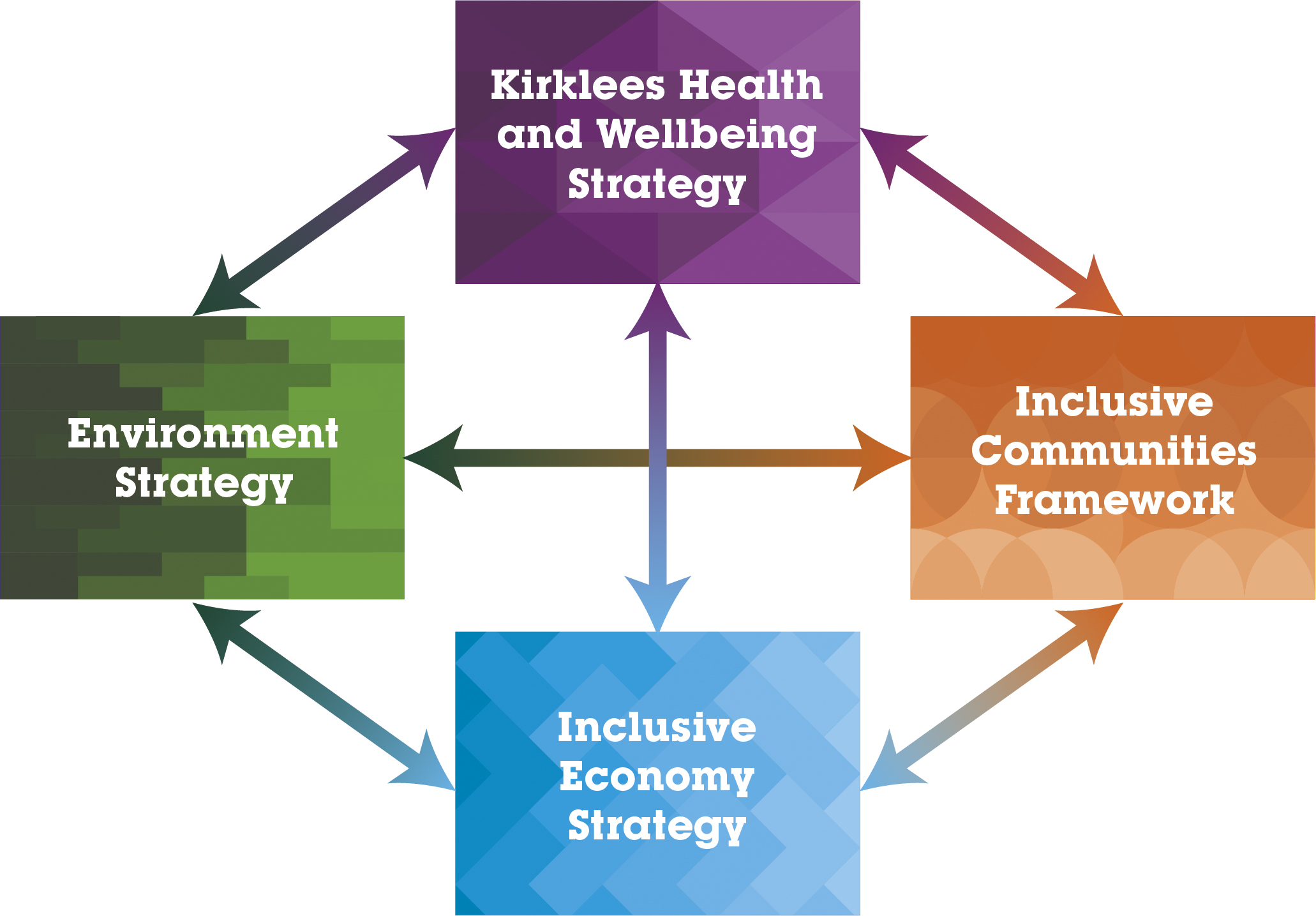
The inclusive economy strategy is one of four top-tier strategies for Kirklees - the others being the inclusive communities framework, the joint health and wellbeing strategy, inclusive economy strategy, and the environment strategy. They are based on shared principles or 'building blocks,' namely:
- tackling inequalities must be at the heart of all we do.
- working together we can achieve more than as individual organisations and must use all the levers we have available to us as anchor organisations.
- one size does not fit all and the approach we take must reflect the different assets and needs of our places, residents and businesses.
- change must be made sustainable through partnership, by sharing power and where possible 'getting out of the way' where appropriate.
- our environment is important, and we need to think 'green' and think local
- fair work is a vital way to enable good mental health.
Local economic development is dependent on a supportive local plan. One that creates space for new quality housing in sustainable neighbourhoods but also space for businesses to start and grow. Under the current Local Plan adopted in 2019 we have seen an increase of around 930 jobs per annum but we know that land supply has remained a limiting factor on business growth. Specifically, there is high demand for business premises in parts of the district where it cannot currently be met due to limited availability of land and premises suitable for the needs of modern businesses. The council is currently updating our Local Plan. The new plan will create opportunities for development of new business and industrial premises, in the right places, to address this demand, and support an even greater rate of job creation.
