Making a difference
The rainbow model
Health and wellbeing can be influenced by many different things. The 'rainbow model' shows that there is a relationship between a person and a wide range of factors. Everything from:
- what people do, their behaviour and choices.
- how they feel, about themselves and the world around them.
- to the broader social, economic, cultural and environmental conditions they live in.
These factors will be different for people at different stages of their 'life course', as people are born, grow, live, work and age. A person's experience is also shaped by the distribution of money, power and resources. Many of these factors overlap and interact, and affect people in different ways, according to their age, gender, ethnicity, sexuality and disability.
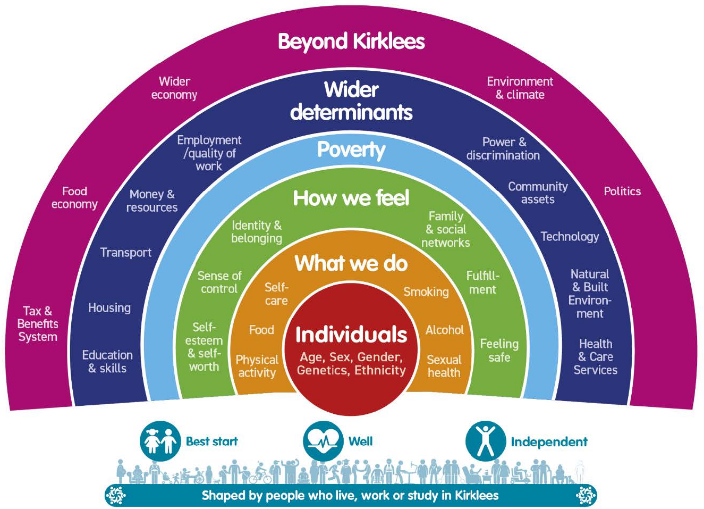
These individual lifestyle factors include:
- Physical activity.
- Food.
- Self-care.
- Smoking.
- Alcohol.
- Sexual health.
- Self-esteem.
- Sense of control.
- Identity and belonging.
- Family and social networks.
- Fulfilment.
- Feeling safe.
These conditions include:
- Education and skills.
- Housing.
- Transport.
- Money and resources.
- Employment and quality of work.
- Power and discrimination.
- Community assets.
- Technology.
- Natural and built environment.
- Health and care services.
The conditions include:
- Tax and benefits system.
- Food economy.
- Wider economy.
- Environment and climate.
- Politics.
When viewed this way we can see that acting on single factors in isolation is likely to provide only a partial and incomplete response. Rather than acting on individual issues we need to adopt approaches that recognise and respond to this range of factors. So we can tackle the 'causes of causes' of poor health and wellbeing for example; unhealthy behaviours are not usually the origin of poor health, but the end point of a long chain of causes and consequences in people's lives.
Reflecting this wide range of issues that impact on people's health and wellbeing, the Kirklees health and wellbeing strategy needs to focus not just on the 430,000 people of all ages who live in Kirklees, but also those people who work or study here too. This is also crucial as workplaces, schools, colleges and the University are all key partners in delivering the Kirklees health and wellbeing strategy.
Reflecting this wide range of issues that impact on people's health and wellbeing, the Kirklees health and wellbeing strategy needs to focus not just on the 430,000 people of all ages who live in Kirklees, but also those people who work or study here too. This is also crucial as workplaces, schools, colleges and the University are all key partners in delivering the Kirklees health and wellbeing strategy.
How will we know we're making a difference
1. We will take action on the Kirklees health and wellbeing strategy shared outcomes and key priorities which are; mental wellbeing, healthy places and connected care and support.
2. By delivering key partnership strategies and plans as well as individual organisations corporate plans, some of which include;
3. Action that is being taken by people who live, work or study in Kirklees.To embed the Kirklees health and wellbeing strategy and turn the strategy into action, we will promote a culture of 'check and challenge' against:
- The Kirklees health and wellbeing strategy vision, values and ways of working
- Delivering on the 'I' statements, what's important to local people
- Achieving the ambition, delivering the local partner actions and progress against the success indicators for each of the 3 Kirklees health and wellbeing strategy priorities
- Consideration of the 6 factors in delivering the Kirklees health and wellbeing strategy priorities and key strategies and plans
- Contributing to other top tier strategies, the 8 Kirklees shared outcomes and the West Yorkshire health and care partnerships 10 big ambitions.
Where the check and challenge will happen
- In individual organisations and services.
- In formal and informal partnerships.
- In the statutory governance structures in Kirklees. The health and wellbeing board has overall responsibility for the Kirklees health and wellbeing strategy and will hold partners and partnerships to account for their contribution to delivering the Kirklees health and wellbeing strategy.
To support the check and challenge processes, we are further developing the existing Kirklees shared outcomes framework. The framework has 3 levels:
The Kirklees shared outcomes and the headline indicators: These are well established and are used to inform the Kirklees Joint Strategic Assessment. The health and wellbeing board will monitor progress against these through the annual refresh of the Kirklees Joint Strategic Assessment.
System performance measures: These are the next level of detail for specific outcomes and specific issues/populations. Each of the Kirklees health and wellbeing strategy priorities has identified a small number of 'success indicators' they will use to monitor progress. Where appropriate these include the shared outcome headline indicators. These system performance measures will be monitored through the appropriate Partnership structures for the specific issue/population. The health and wellbeing board will also receive regular updates from the relevant Partnerships structures, particularly focussed on the 3 Kirklees health and wellbeing strategy priorities.
Organisation or Service Specific Measure: There are a wealth of organisation and service specific performance measures, many are part of national outcomes frameworks and reporting structures. These are important in enabling organisations manage their services and are embedded in organisation performance monitoring systems. The focus of the Kirklees health and wellbeing strategy needs to be on the Kirklees shared outcomes and system performance measures described above.
