Insights from the National Gallery: Art on your doorstep, curator's tours
29th June 2026
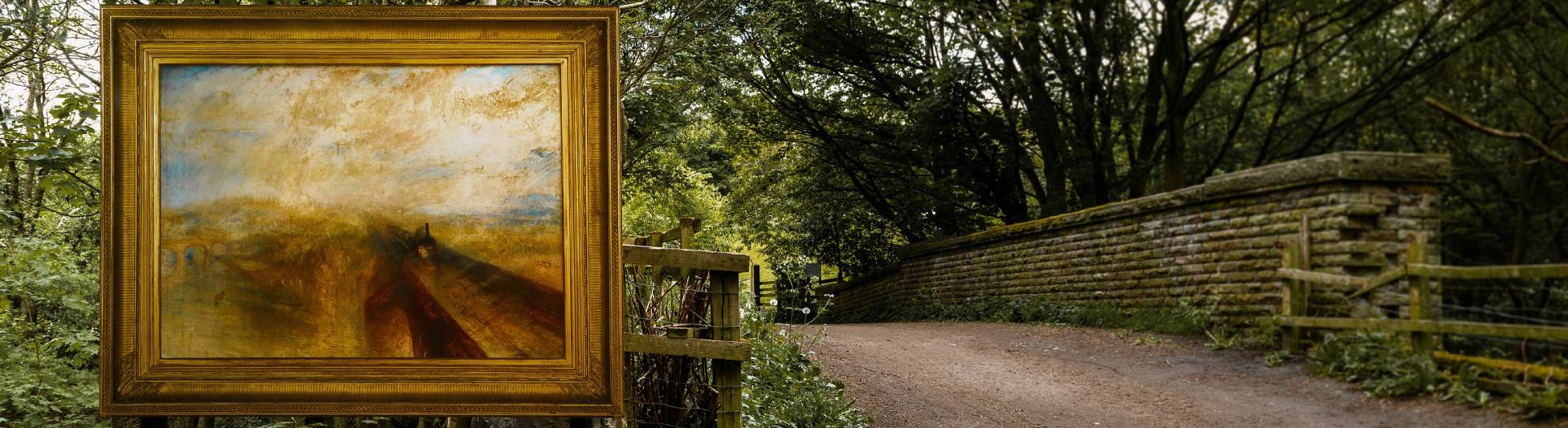
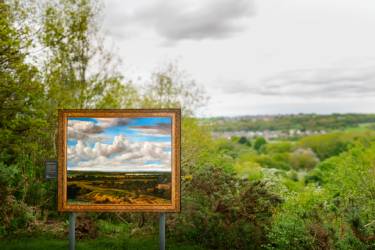
We are now halfway through our outdoor exhibition The National Gallery: Art On Your Doorstep, which has brought fourteen life-size reproductions from the National Gallery into the landscape at Oakwell Country Park.
We're sharing insights from exchanges during several of our Curator's tours, which have been taking place since the exhibition opened on 4th April. These tours, led by Visual Arts Curator Dr Janine Sykes, took visitors around the paintings and through the lush landscape that surrounds the hall.
The sold-out tours were open to everyone and have been attended by the public, community groups, such as Oakwell Well-being Walks and the Friends of Oakwell Hall, and invited guests, such as New Zealand author Jane Tolerton, and performance artist The Frog (Simon Woolham).
These reflections capture one of the most valuable aspects of any exhibition: the exchange of ideas, experiences and knowledge between visitors, artists and place.
April
The first Curator's tour took place on one of the first truly sunny days of 2026.
It was part of The Frog in the Park event with performance artist Simon Woolham and filmmaker Jay Zjawinski.
The Frog had already made a lot of visitors smile, laugh, and giggle before we met the twenty tour participants in the courtyard. We walked, hopped, and played around the art, stopping at each print. I pointed out that the interpretation in the object labels had been co-authored by three community groups, and drew further connections to the heritage of Oakwell Hall, the country park, and the wider area of Birstall, Kirklees, and Yorkshire.
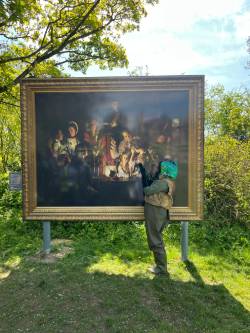
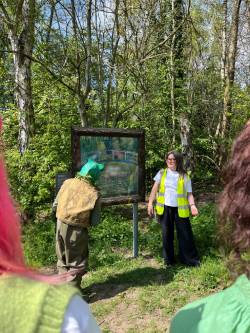
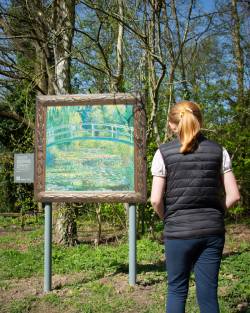
Highlights of the event included the way that the frog mirrored the body language of figures in paintings and pointed to tiny details, like a frog in Monet's The Water-Lily Pond (1899). While looking closely at The Hay-Wain by John Constable, one young visitor spotted a wooden barrel, just underneath the surface of the river Stour, a detail we hadn't seen before. When I asked what the group thought was in the barrel, comically the Frog shouted 'sewage!'.
On the way to Surprised! (1891) by Henri Rousseau, a young person shared their experience of studying the painting at school. It was lovely to hear that the facial features of a tiger depicted in a nineteenth century painting were fascinating to a young person today.
Also in April, I joined a walking group who meet regularly at Oakwell. The group had a lot of knowledge of local history; one member was in the Morley History Society and two were members of Batley History Group. When we looked at Turner's Rain, Steam and Speed (1844), a member shared information about how the disused railway line that runs through the park had been used as a faster track than Dewsbury's, which was slow because it was heavily used by freight trains.
May
In May, local MP Kim Leadbeater had a short tour after finishing the Oakwell parkrun. During our discussions, I was struck by how many of the paintings seemed to spark political conversations. Turner's Rain, Steam and Speed was once again mentioned with the realisation that when the Leeds New Line was in operation in the early twentieth century, Birstall was arguably better connected than it is today. By the time we reached Gainsborough's Mr & Mrs Andrews (1750), we had discussed land ownership, and by Holbein's The Ambassadors we had touched on strained relations with Europe, a subject of long debate since 1533!
June
In June, a group of invited guests including Councillor Karen Allison and ladies from the Friday Wanderers toured the paintings as part of the exhibition's celebratory event. Caspar David Friedrich's A Winter Landscape (c.1811) got a lot of attention, and Trees Fewster, Churchwarden of St Mary's Gomersal, asked whether the beautiful Gothic architecture depicted in the painting was based on a particular cathedral.
Although these interactions took place over different months by different groups, they demonstrate a genuine engagement with the works. Viewers easily linked them to current issues and interests, whether this was politics, contemporary water pollution in UK rivers, or wildlife (like frogs).
As summer turns to autumn, I look forward to seeing how visitors will continue to interact with the artworks. We have already been blown away by the community responses and have loved watching you explore our green spaces in new ways.
The exhibition continues until 30th September, when a closing event will take place. See more details of the programme or view the full digital exhibition on Bloomberg Connects.