Folklore at Oakwell Hall
When you visit Oakwell Hall, you may come across objects and markings associated with folklore, protection, and superstition. These features offer a fascinating insight into how people in the Tudor and post-medieval periods understood and responded to the world around them.
Read on to learn more about some of these items.
Witch balls
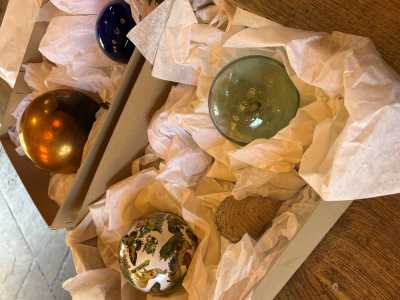
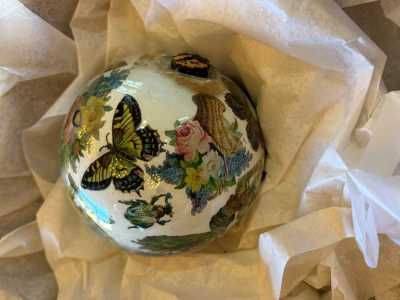
'Witch balls' are decorative glass ornaments shrouded in centuries of folklore.
While their original purpose remains uncertain, historians continue to debate whether these objects were functional or simply decorative. Although they originated in the 17th century, the Victorians popularised the belief that they could protect homes from evil spirits.
Their vivid colours and reflective surfaces were thought to guard against the 'Evil Eye', an ancient curse believed to stem from envy or malicious intent. It was believed that these features could attract and capture harmful spirits or bad luck before they reached the household, with some folklore even suggesting that witches could be trapped by their own reflection.
Some historians have proposed that the name is a misunderstanding of a 'watch ball'. Hung near a doorway or fence, their reflective surface could reveal anyone approaching the house, acting as an early version of a burglar alarm. Others suggest that witch balls had more practical origins like drying salt in front of fires (salt was thought to protect against evil spirits).
Another popular theory is that they developed from the buoys used for fishing nets, as sailors' wives would hang the glass floats in windows to protect their husbands out at sea. The connection to witches may have come from the witch trials of the 17th century when suspected witches were tied up and thrown into water: if they sank, they were innocent; if they floated, this was taken as evidence of witchcraft. Since fishing buoys also floated, this may have contributed to the association.
Yet, by the late twentieth century, they had largely become decorative ornaments. Their contested history shows how meaning shifts over time while still carrying traces of older folklore and beliefs.
Burn marks
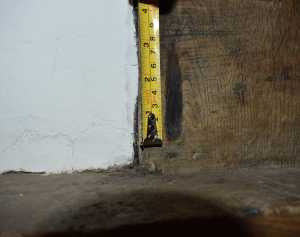
In Oakwell Hall, particularly surrounding doorways and in The Kitchen, blackened marks can be seen on several wooden beams. These are not accidental, but purposeful.
Research is ongoing, but current evidence suggests that these burn marks may have been apotropaic, meaning they were intended to ward off evil or bad luck. Some of the reasons they were made could be:
Protection from fire
There was a belief that burning a small part of a home could somehow protect the building from a larger fire through sympathetic magic. To fight fire with fire.
Protection from evil
Medieval and Tudor people commonly believed that evil spirits, witches and supernatural forces could enter buildings through vulnerable places such as doors, windows or chimneys. Frequently burn marks are found around these exact locations.
Praying, healing, or purification
Some Tudor homes like Oakwell Hall have marks which are found low down on walls, suggesting that someone may have been kneeling while creating them. It can be imagined that they could represent prayers or healing rituals.
Bartmann jugs
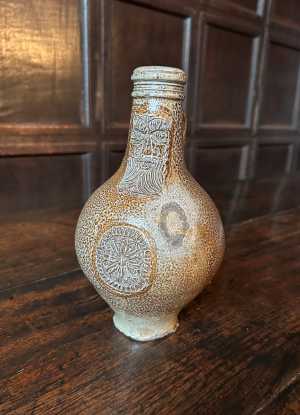
This funny-looking jug is called a Bartmann or Bellarmine jug. They were made as early as the 15th century and come from Germany. Characterised by their unique shape and decoration, which often featured grotesque faces and applied medallions, they were primarily used for storing and transporting liquids such as beer, wine, vinegar, and even mercury.
The name 'Bartmann' comes from the German word for 'bearded man' and refers to the facial decoration on the jugs. The faces are often designed with dramatic features such as bushy eyebrows, long beards, and large noses. These designs were likely influenced by the popular engravings of the time, which often featured similar facial images.
Sometimes, a Bartmann jug was repurposed as a 'witch bottle' containing a range of substances, some rather unusual. Commonly they were filled with rosemary, needles, pins (which are sometimes bent), and red wine. Many witch bottles contained personal items such as urine, hair, nail clippings, or other bodily materials, which were believed to strengthen their protective power. They were added as the ingredients of a 'prepared cure' to fight against witchcraft. Once the ingredients are added, they were stoppered or sealed and then hidden.
'Witch bottles' have been recovered from inns, colleges, and domestic dwellings in both rural and urban buildings around the UK. They are always found on their own and almost exclusively in one of these three places within a building:
- Beneath a floor.
- Under a doorway.
- In or around a chimney.
Importance of the objects
Together, witch balls, burn marks, and Bartmann jugs tell us about how people in the past understood the world around them.
They show us that folklore was not just storytelling or superstition. It could influence the objects people made, the buildings they lived in, and the desire they felt to protect themselves, their families, and their homes.
Historically, people deliberately interacted with their surroundings in ways that reflected their fears, beliefs, and understanding of the world. Everyday actions, from leaving protective charms in buildings to following folk traditions and superstitions, reveal how people sought to guard against misfortune, influence unseen forces, and make sense of the uncertainties of life.
Healing Heritage at Oakwell Hall and Country Park
While beliefs about protection and wellbeing have changed over time, Oakwell Hall continues to explore how heritage, nature, and traditional practices can support people's health and wellbeing today.
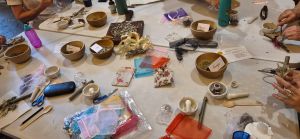
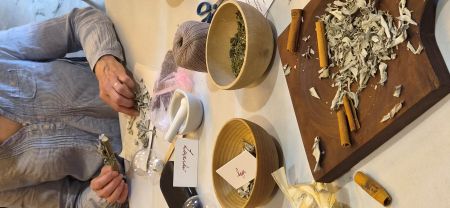
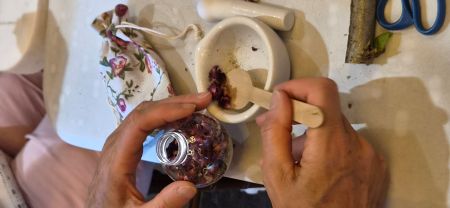
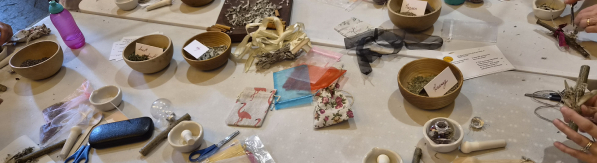
Since 2025, Sasha Handley, Professor of Early Modern History at the University of Manchester and founder of the 'Sleeping Well Project' has been working with Oakwell Hall to design and support the delivery of new health and wellbeing interventions, based on historic practices. This 'Healing Heritage' programme includes workshops exploring the museum collections and use of herbs for adults, children and families, as well as discovery trails, guided walks, and bespoke events for local community groups.
Together with Oakwell Hall, they have been able to produce successful wellbeing interventions for members of the public and Country Park users.
Look out for more Healing Heritage sessions on our website.