Coal balls, palaeobotany, and why they matter
About coal balls
Well, it is not Coal and more often than not, not ball shaped. They range from a few centimetres to 2 tons in size. It is a calcareous concretion which means it is made from Calcium and Magnesium Carbonate, the same stuff as the limescale found in your kettle. In this case the carbonate has infiltrated the cells of plants preserving all the delicate structures that lived 300 million years ago. This process is known as 'permineralisation'.

How a coal ball is formed
The process is not fully understood. It seems to be most prevalent in the Carboniferous period, 300 million years ago, although some researchers have found more modern sites where it is potentially happening today.
The coal ball is found within the coal seam with coal surrounding the concretion. This means it started to become permineralised before the coal formed. Within the coal ball the plant material has not decayed which means there was a lack of oxygen, similar conditions to those found in swamps. This allows peat to form which is later compressed to form coal. Despite the number of coal seams found in the UK, only 2 or 3 yield coal balls so they are rare.
Researchers have tried to understand where the Carbonate comes from. There are three main theories:
- From the sea as sea levels rise and then percolate the swamp and therefore the plants.
- Storms have washed over sand barriers into the swamp.
- Groundwater carrying the carbonate (e.g. hard water) has infiltrated from below. The coal balls in our collection are more likely to have been formed from freshwater from below.

Why a dull brown rock is important
The magic happens when the coal ball is sliced into a very thin layers. There are then 2 options;
- Create thin sections where the slice is ground down with diamond discs, so it is thinner than your hair.
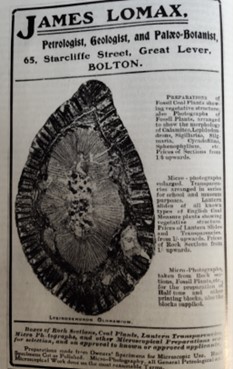
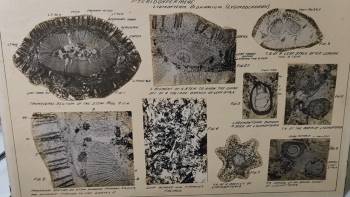
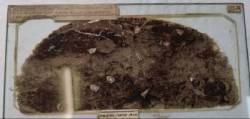
- The peel technique - the slice is polished then etched with acid. The sample is drowned with acetone and a piece of cellulose Acetate is positioned on the acetone. This partially melts the acetone. The acetate can then be peeled off taking with it a very thin slice of Coal Ball. The images below use the peel technique.
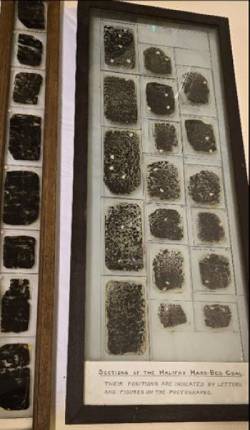
Both methods can then be mounted onto microscope slides. A series of slices can be collated similar to a CT hospital scan, revealing the structure of the plants.


Prior to the discovery of Coal Balls, palaeobotanists had to rely on compressed fossils of plants. The roots, for instance, were not connected to the stems and the stems were not connected to leaves. Each part of the plant would be given a different scientific name whereas a living plant today would be given a name that covers the whole plant e.g. roots, leaves, stems, reproductive organs, seeds / spores etc.
So a Lepidodendron tree might have fossils called Stigmaria (roots), Lepidodendron (trunk), Lepidostrobus (cone). Coal Balls changed all that by showing how all these individual fossils are connected together to form the whole plant.
Where coal balls are formed
Although there are some isolated locations dotted across the UK, the main sources are from East Lancashire (Burnley down to Ashton Under Lyne) and Halifax and Huddersfield. Despite the distance between, say, Todmorden and Halifax the same coal seam appears in both places. There is less mention of coal balls in Huddersfield however Tolson's collection shows that the town did contribute to this research.
They are also of global interest. Illinois in America has a warehouse full of coal balls being researched today and China and Ukraine also have coal balls.
When research was carried out
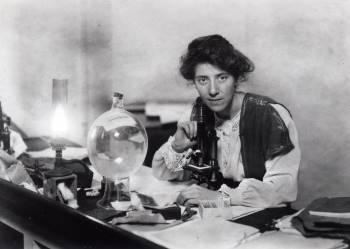
In the UK most of the research was carried out at Manchester University in the late 1800s and early 1900's. Botany was a very prominent science and expert knowledge was required to interpret the coal ball slides. One of the key botanists at the time was Marie Stopes (later famous for her trailblazing support of birth control clinics). She saw the coal balls in the coal seams and suggested that they had been formed in-situ.
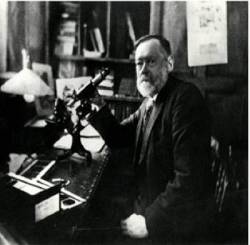
This was argued against by James Lomax (the person who sourced the coal balls from the miners and prepared the microscope slides). He suggested they had been washed into the coal e.g. by streams or the sea. As a woman, Stopes was battling against the male dominated scientific community which mainly came down on the side of Lomax.
But in time Stopes proved the in-situ theory when she found a two tonne coal ball which quite simply couldn't have been washed in. Stopes continued to work with Lomax for 20 years with the formation of the Lancashire and Cheshire Coal Research Association which looked at the composition of Coal (the minerals formed from the different parts of the plants) and the reconciliation of Coal Seams across the country.
The Tolson collection
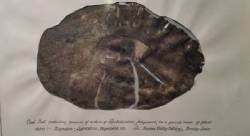
The Tolson collection includes several large coal balls. Some are whole, some have been prepared for microscope slides, and some peels are mounted in frames for display. There are also several display boards describing how the Coal Balls had been prepared.
There are around 20 large Lomax microscope slides, some are in very good condition whereas others have been damaged over time. Unfortunately, some of the Coal Balls have a high Pyrite (Iron Sulfide) content and this reacts with the air and reduces the Coal Ball into dust. Fallhouse Colliery in Deighton seemed to be main source of Coal Balls in Huddersfield.
Next steps
We have already visited Manchester Museum which holds the Palaeobotany collection for Manchester University to discuss the best way of preserving the Tolson Collection. Our aim is to photograph the microscope slides and, where possible, the peels.
This fascinating slice of natural history can tell us so much about the past and we want to preserve the collection for many years to come.